Jesus said “I AM” – But What Did He Mean?
Summary (getrecall.it)
The Biblical Significance of I Am
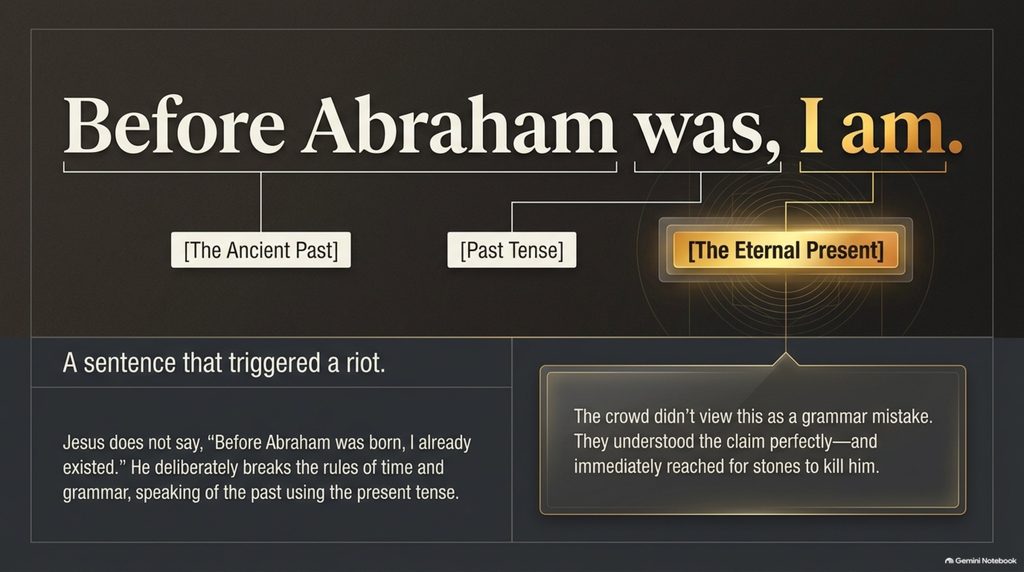
- Jesus stated, “Before Abraham was, I am,” using the present tense “I am” rather than a past tense construction like “I already existed” (00:00:00).
- The statement caused an immediate and violent reaction from the crowd, who picked up rocks to kill Jesus for his words (00:00:26).
- The phrase “I am” is central to the mystery, with the word “I” serving as a potential focal point for understanding the claim (00:00:48).
Historical Origins of the Divine Name
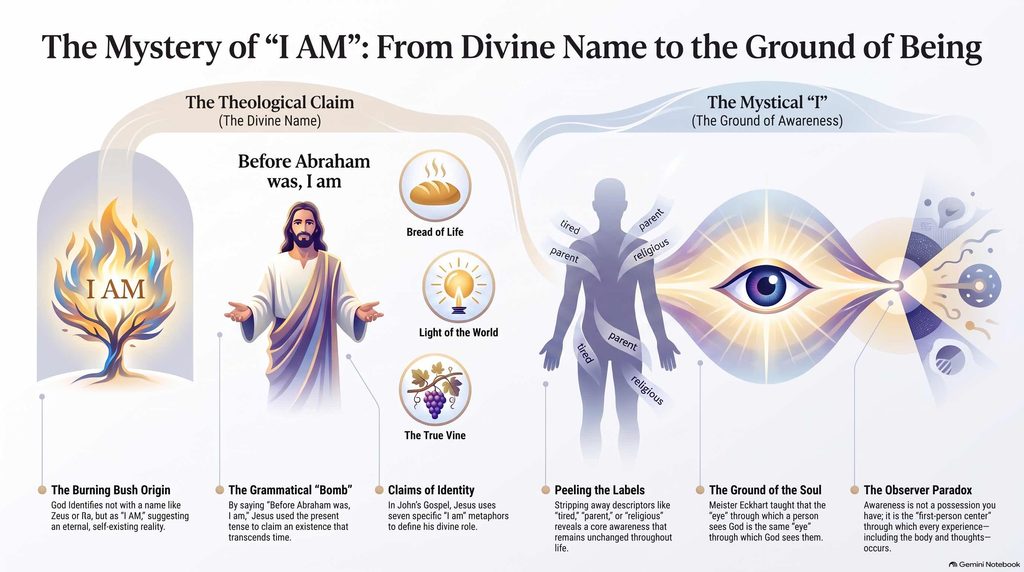
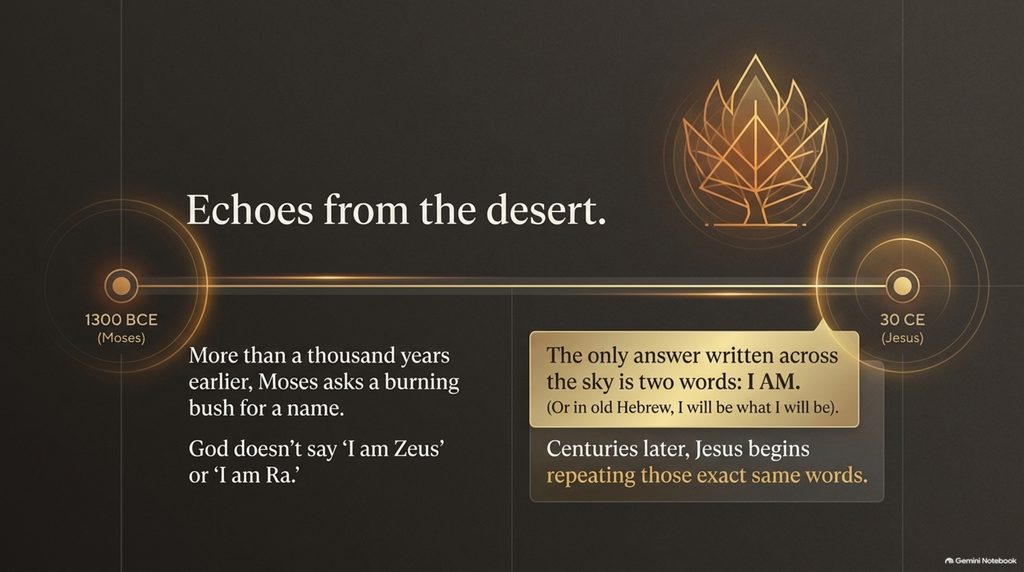
- The historical context of this phrase traces back to Moses, who encountered a burning bush in the desert and was instructed by a voice to free his people from slavery in Egypt (00:01:28).
- When Moses asked for the name of the god who sent him, the response he received was “I am” (00:01:56).
- Scholars note that the original Hebrew phrase is complex and may also be interpreted as “I will be what I will be,” though the exact meaning remains a subject of long-standing debate (00:02:13).
- Unlike other deities who might provide specific names, the entity in the burning bush identified itself only as “I am” (00:02:42).
Theological Interpretations of Jesus’ Claims
- In the Gospel of John, Jesus repeatedly uses the “I am” phrasing, such as “I am the bread of life,” “I am the light of the world,” and “I am the good shepherd” (00:03:26).
- By using the present tense “I am” in reference to Abraham, who lived long before him, Jesus claimed an existence that is “always now” rather than merely existing in the past (00:04:01).
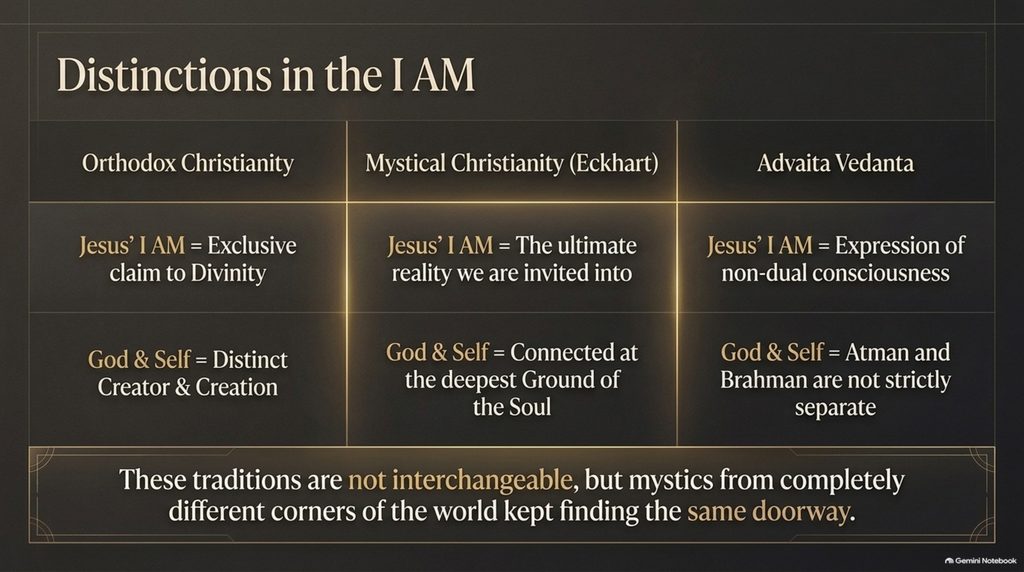
- The crowd’s attempt to stone Jesus indicates they understood his statement as a significant claim, which most Christians throughout history have interpreted as a declaration of his divinity (00:04:35).
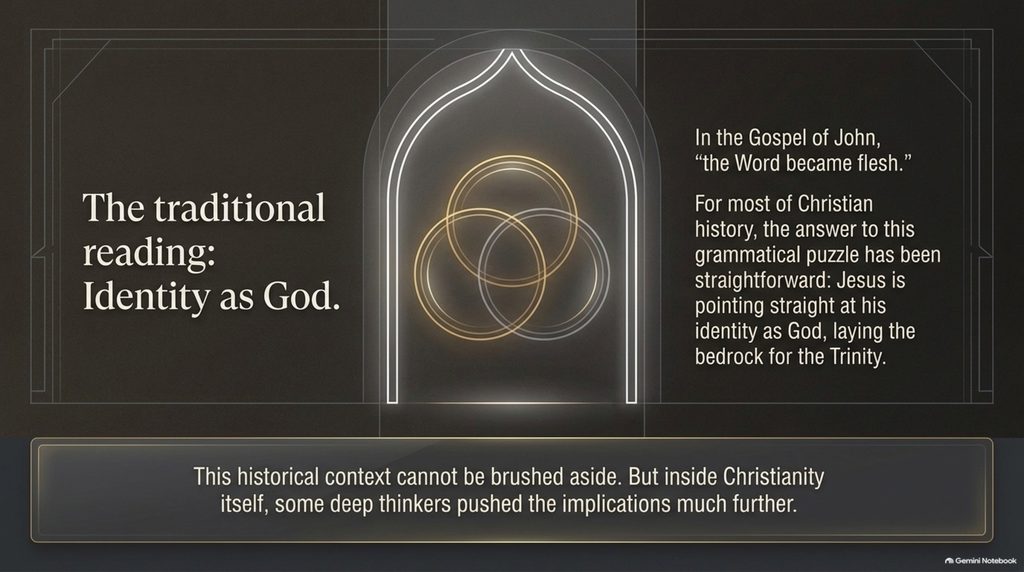
- The Gospel of John supports this interpretation by beginning with the assertion that “In the beginning was the word” and “The word was with God” (00:04:54).
- The Gospel of John identifies the “word” as God and states that this word became flesh in the person of Jesus. (00:05:08)
- Jesus’ use of the phrase “I am” is interpreted as a declaration of his identity as God, serving as a foundational element for the Christian doctrine of the Trinity. (00:05:16)
Oneness and Intimacy in the Gospel of John
- Applying modern concepts of “pure consciousness” to the phrase “I am” is considered an imposition of contemporary ideas onto a specific historical and religious context. (00:05:35)
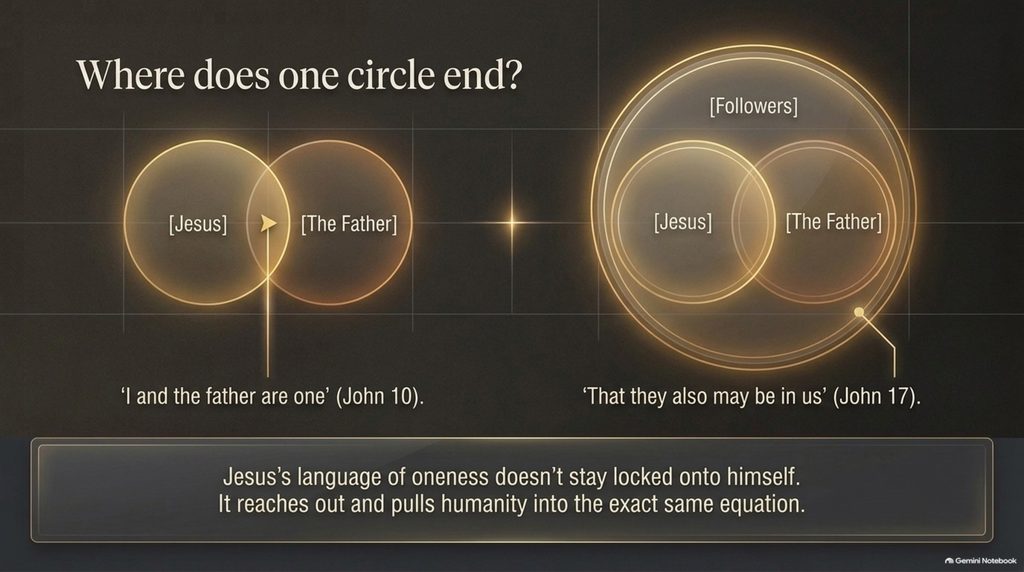
- In John 10, Jesus claims that he and the Father are one, a statement that is expanded upon in John 17 when Jesus prays for his followers to share in that same oneness. (00:06:06)
- The language of oneness in the Gospel of John extends beyond Jesus to include his followers, suggesting a deep intimacy between Jesus, the Father, and those who believe in him. (00:06:35)
Meister Eckhart and the Ground of the Soul
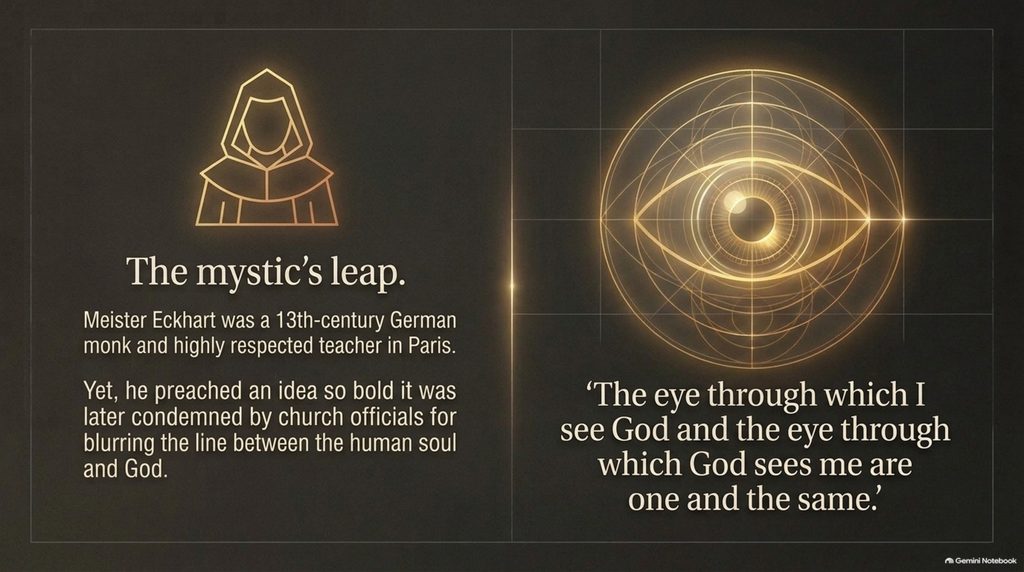
- Meister Eckhart, a respected German Dominican preacher and teacher active between the late 1200s and early 1300s, explored the connection between the human soul and God. (00:07:06)
- Although Eckhart was a prominent figure within his order, some of his sermons were perceived as radical, leading to a formal church condemnation of his teachings after his death for allegedly equating the human soul with God. (00:07:40)
- Eckhart maintained his commitment to the Christian faith and expressed a willingness to retract any statements found to be false, suggesting his radical language was an attempt to describe an ineffable experience. (00:08:06)
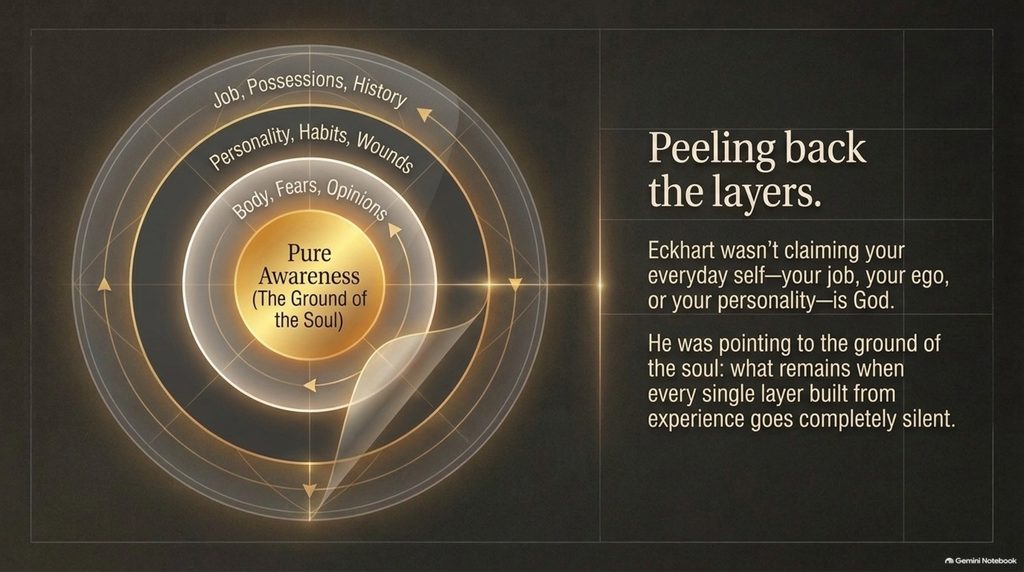
- Eckhart proposed the concept of the “ground of the soul,” describing it as the deepest layer of a person where the act of seeing God and being seen by God are identical. (00:08:32)
- Eckhart’s teachings do not equate a person’s everyday self—including their personality, memories, or social roles—with God, but rather point to a deeper, underlying essence that exists beneath these layers. (00:08:59)
Distinguishing Transient Roles from Underlying Existence
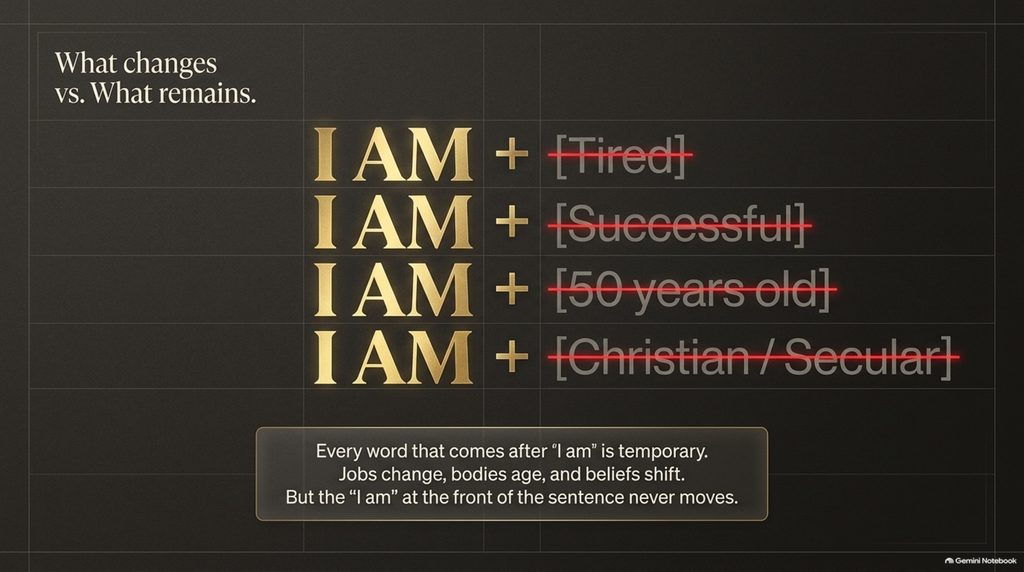
- The phrase “I am” is frequently used in daily life to describe transient states or roles, such as being tired, afraid, or holding a specific job, all of which are subject to change over time. (00:09:50)
- Personal beliefs may shift throughout a person’s life, yet the sense of “I am” remains constant (00:10:18).
- By systematically removing labels, descriptions, and observable traits—such as age, religious affiliation, personality, or physical body—one is left with a simple, underlying sense of existence (00:10:34).
Christian Mysticism and the Kingdom of God
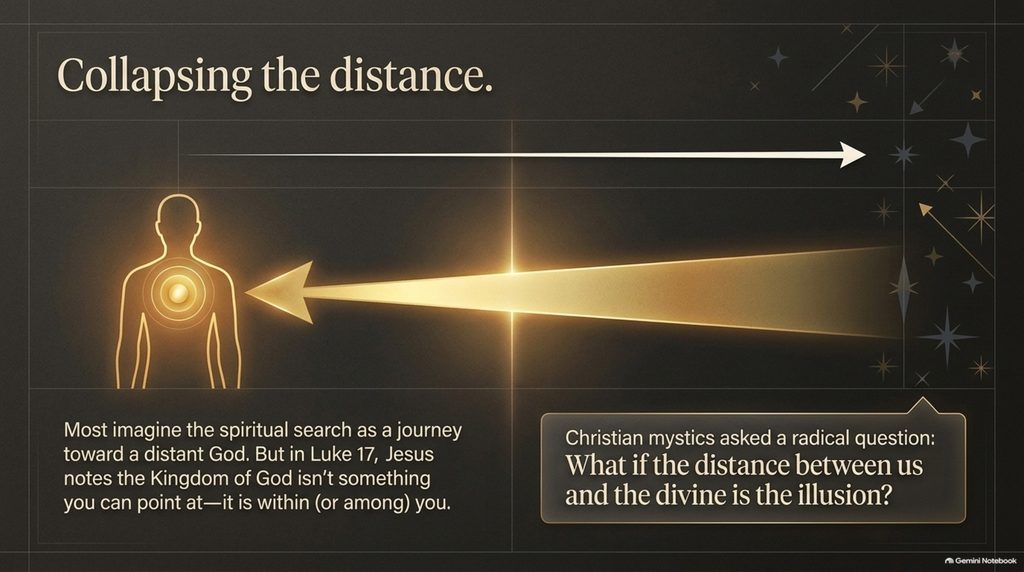
- In Luke 17, Jesus addresses inquiries regarding the arrival of the kingdom of God by stating it is not something that can be observed or pointed to externally (00:11:13).
- The Greek phrasing used by Jesus regarding the kingdom of God can be translated as “among you” or “in your midst,” suggesting that the concept should not be limited to the English interpretation of “within” (00:11:26).
- Christian mystical traditions have historically emphasized an inward focus and a direct encounter with God, challenging the common perception that God is a distant entity requiring travel to reach (00:11:53).
- Some Christian mystics proposed that the perceived distance between the individual and God is an illusion (00:12:13).
Comparative Perspectives on the Nature of Self
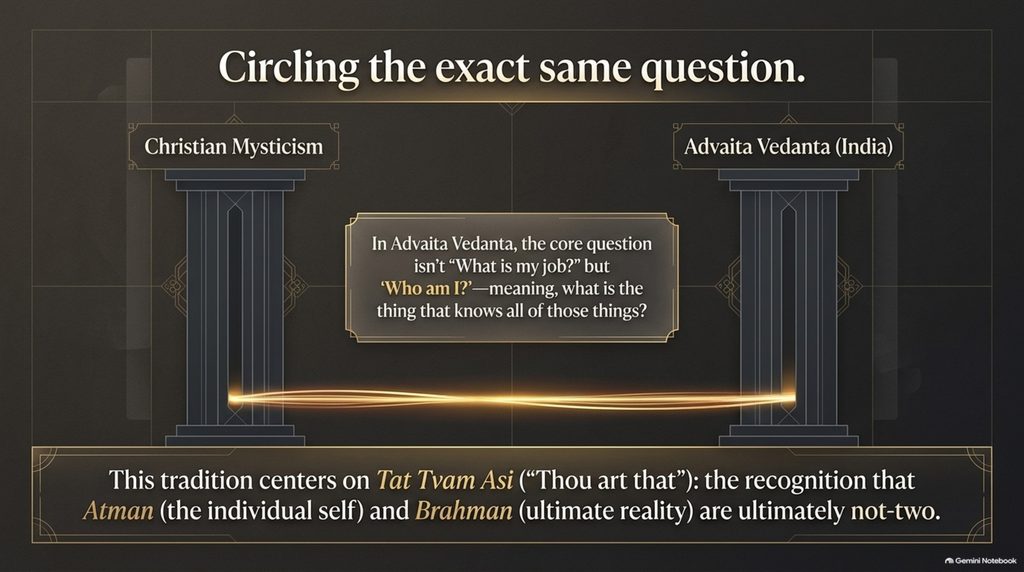
- The Hindu school of philosophy known as Advaita Vedanta explores the question “who am I?” by seeking to identify the entity that possesses knowledge of one’s life, name, and experiences (00:12:41).
- Advaita Vedanta utilizes the concept of “That thou art,” which posits that Atman (the individual self) and Brahman (the ultimate reality) are not separate (00:13:06).
- While Christian theology and Advaita Vedanta are not interchangeable and handle distinctions differently, mystics from diverse traditions often converge on the question of the nature of the “I” (00:13:37).
The Search for the Observer
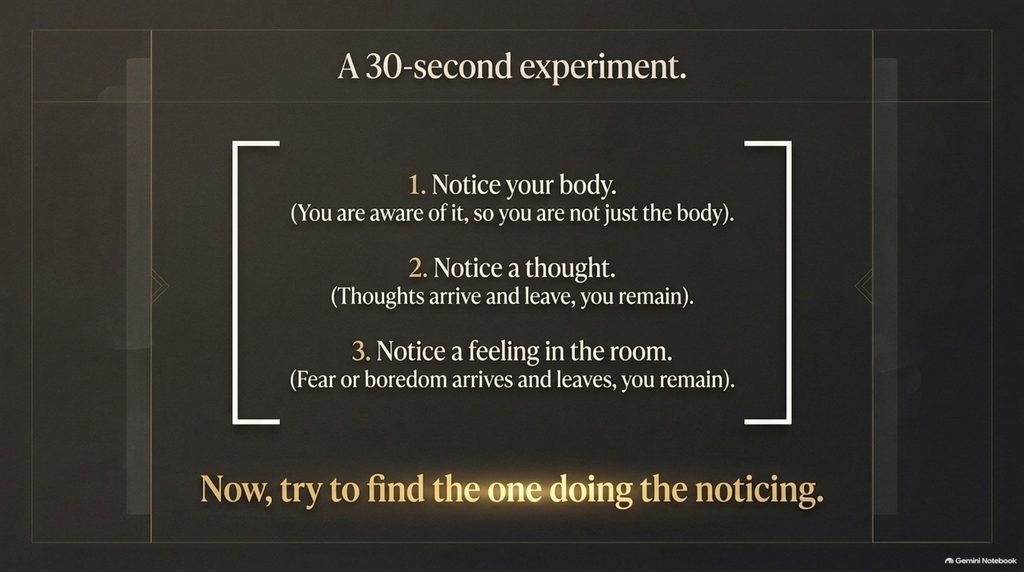
- An exercise in awareness reveals that the body, thoughts, and feelings are objects that appear within one’s awareness, rather than being the awareness itself (00:14:14).
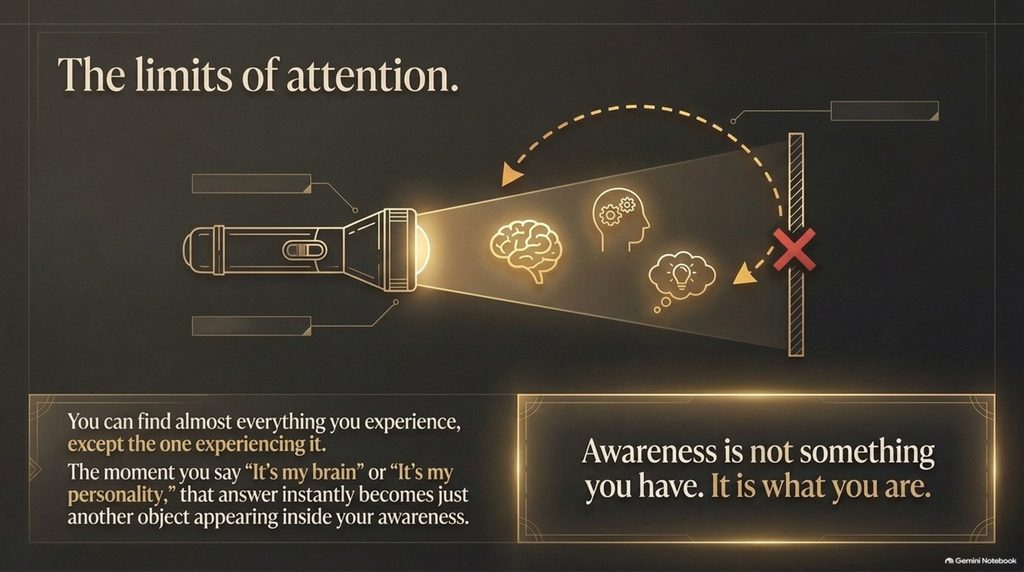
- Because any answer to the question “who am I?”—such as one’s brain, personality, or thoughts—can be observed as an object, these answers are ultimately distinct from the observer (00:15:11).
- Thoughts are transient phenomena that appear and disappear, which prompts the search for the observer or the entity responsible for noticing these thoughts (00:15:39).
- While most experiences can be identified as objects of attention, the observer itself remains elusive because the act of focusing on it creates a new layer of awareness (00:15:51).
- This process of looking for the observer is described as a doorway that mystics from various traditions across the world have historically explored (00:16:13).
Experimental Inquiry into Awareness
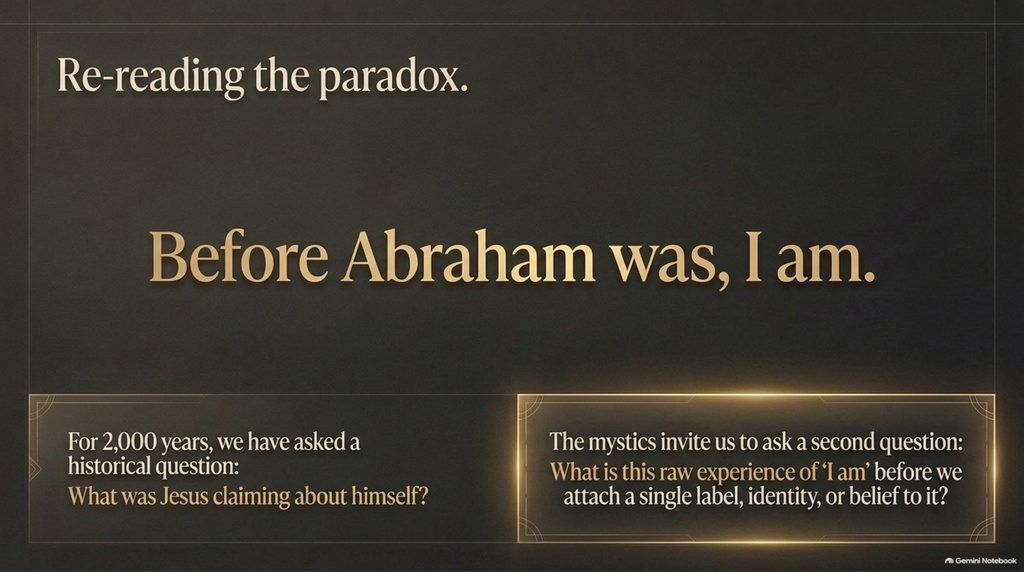
- The statement attributed to Jesus, “Before Abraham was, I am,” has been the subject of historical and theological inquiry for 2,000 years regarding his specific claims about himself (00:16:27).
- Beyond the historical question, there is an experimental inquiry into the raw experience of “I am” that exists prior to labels such as personal identity, religious affiliation, social status, or physical embodiment (00:16:50).
- It is not a factual claim to equate the teachings of Jesus with Advaita or to assert that “I am” simply means consciousness is God, as such conclusions are considered leaps (00:17:19).
- The texts contain language regarding being and oneness that aligns with the inquiries of mystics from multiple traditions (00:17:36).
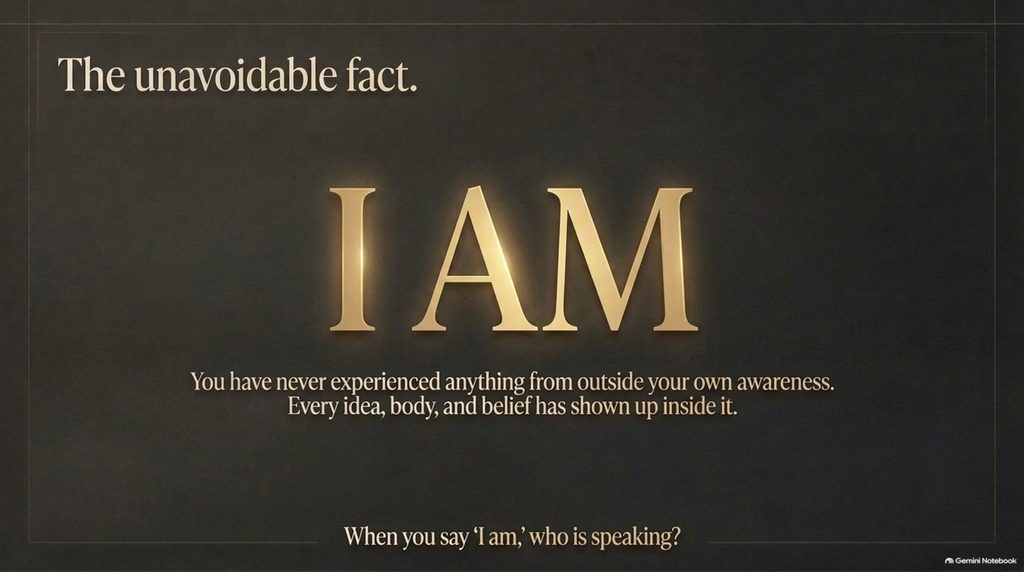
- Every human experience occurs from a first-person center, meaning that everything—including one’s own body, ideas, and perceptions—is encountered within one’s own awareness (00:17:52).
- A fundamental question arises as to whether awareness is a possession one holds or if it is the essential nature of the individual (00:18:22).
Reflecting on the Nature of Being
- Mystics have explored what occurs when the individual searching for God achieves a state of complete quiet (00:18:36).
- An experimental exercise involves attempting to identify the “aware” entity without relying on names, jobs, history, physical body, or thoughts, as these are all objects of which one is aware (00:18:49).
- The phrase “I am” is characterized as powerful because it strips away all descriptors, leaving only the foundational fact of existence (00:19:24).
- The significance of Jesus using the phrase “I am” may be linked to the fact that individuals use the same words daily without conscious reflection (00:19:41).
- A suggested inquiry for personal reflection is to determine who is speaking when one says “I am” (00:19:49).

Leave a Reply