Gunas
The Secret Architecture of the Bhagavad Gita
Concise Summary (getrecall.ai)
- The Bhagavad Gita is structured as a psychological rescue mission, beginning with Arjuna’s physical and mental collapse on a battlefield, which is described as a clinical panic attack rather than simple cowardice (00:01:46)
- The text utilizes a three-part architecture to address this paralysis: first, Karma Yoga encourages acting without attachment to outcomes; second, Bhakti Yoga provides a cosmic perspective to diminish the ego’s anxiety; and third, Jnana Yoga offers a framework of three fundamental energies—tamas, rajas, and sattva—to help individuals understand and navigate their internal states (00:02:15)
- The battlefield of Kurukshetra serves as a metaphor for the human mind, where the true conflict is not against external enemies but against one’s own doubt, fear, and ego-driven attachments (00:13:05)
- Ultimately, the text serves as a guide for overcoming modern paralysis by teaching readers to separate their actions from the results they cannot control, allowing them to stand up and perform their necessary duties (00:15:17)
What are the Gunas? (Dia Browser ai)
In the video, the gunas are the three basic “strands” or qualities that make up everything in nature, including your own mind. They are always mixed together, and the mix keeps changing.
The three gunas
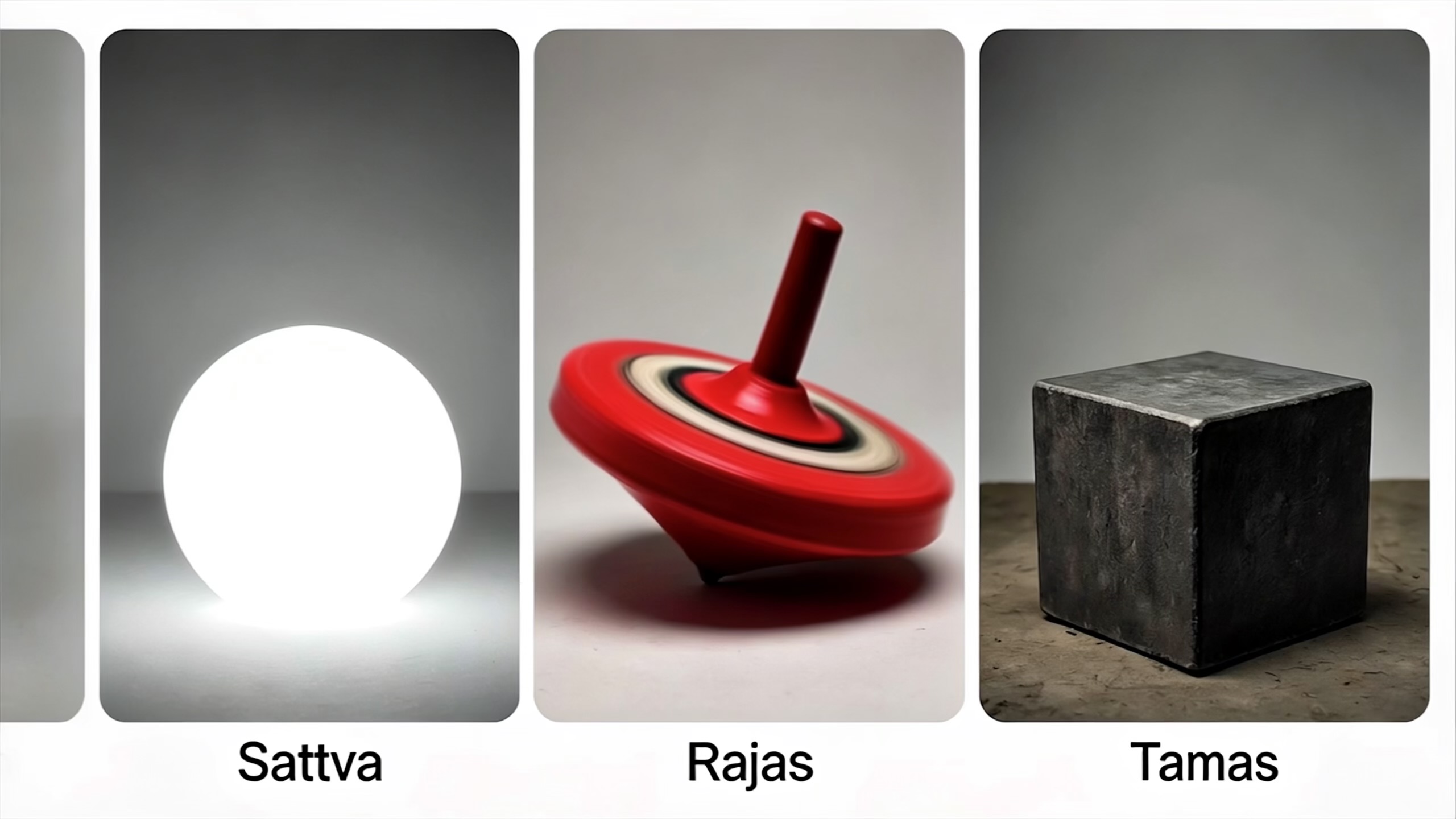
- Tamas: heaviness. Inertia, darkness, lethargy and fog. It’s the dullness that makes effort feel pointless. The video says tamas is what pulled Arjuna down when he collapsed and couldn’t lift his bow.
- Rajas: restlessness. Frenzy, craving, compulsive ambition and a mind that can’t stop. The narrator links it to modern burnout: “constant movement mistaken for progress.”
- Sattva: clarity. Balance and lightness. A quiet mind that sees accurately and acts cleanly, with neither the fog of tamas nor the fever of rajas.
Why Krishna teaches them
The point isn’t just to sort things into categories. The gunas are a tool for reading your own inner state. The trap is thinking “I am anxious” or “I am stuck.” The gunas teach that these states aren’t who you are. They’re conditions that come and go. If you can name which one is in charge right now (“is this heaviness tamas? Is this agitation rajas?”), you can start steering it instead of being carried along by it.
The video also says this teaching comes late in the Gita (the “knowledge” section, chapters 13–18) on purpose. Arjuna first had to calm down before he could take in a framework like this: “You cannot study a map while drowning.”
Some background the video doesn’t cover: the idea of the gunas comes from Samkhya, an older school of Indian philosophy. Chapter 14 of the Gita is devoted to them, and they come back in chapters 17–18, where Krishna applies them to food, faith, charity and action.
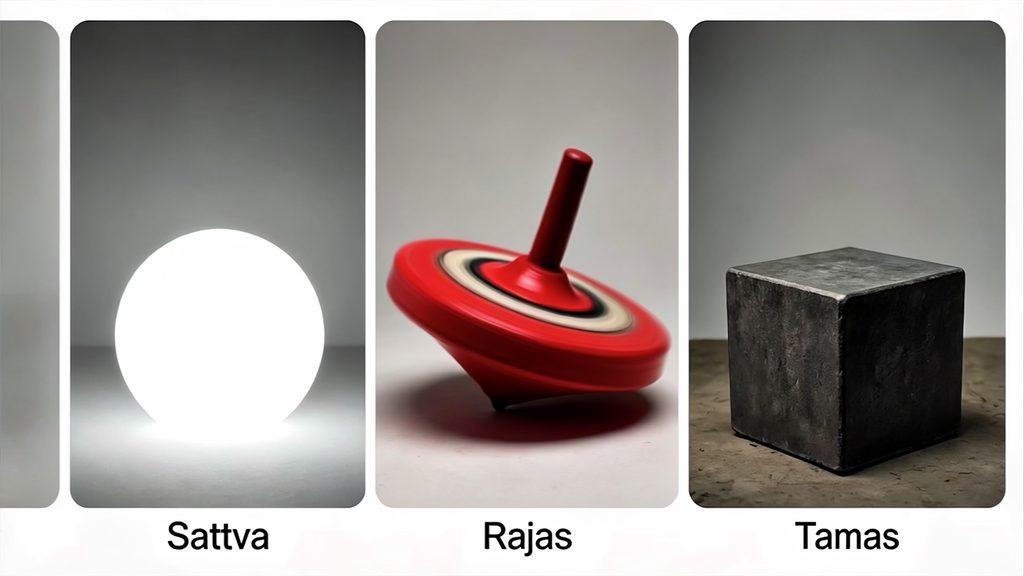
Image: MacOS Image Playground
Sattva, Rajas, Tamas? (Dia browser ai)
These are the three gunas (“qualities” or “strands”). The idea comes from Samkhya philosophy and runs through the Bhagavad Gita, yoga, and Ayurveda. The gunas are the basic forces that make up all of nature (prakriti), including the mind. Everything has all three, mixed in different amounts.
| Guna | Core quality | In the mind | In action | Examples |
|---|---|---|---|---|
| Sattva | Clarity, harmony, light | Calm, insight, contentment | Balanced, done without selfish attachment | Fresh food, quiet mornings, study, meditation |
| Rajas | Energy, passion, motion | Desire, restlessness, ambition | Driven, aimed at results, busy | Stimulants, competition, constant activity |
| Tamas | Inertia, heaviness, darkness | Dullness, confusion, denial | Lazy, careless, or harmful | Stale food, oversleeping, numbing habits |
Key points:
- None of them is simply “bad.” Tamas gives you stability and sleep. Rajas gets things started. Sattva gives clarity. Trouble starts when one of them takes over in the wrong place.
- The usual path is to move from tamas, through rajas, toward sattva. Inertia becomes action, and action becomes clear, calm action.
- The Gita’s view (chapter 14) is that the final goal is to go beyond all three (gunatita). Even sattva can bind you, through attachment to happiness or knowledge.
- In Ayurveda and yoga, the gunas are used to sort food, habits, and states of mind.
Leave a Reply